Tuesday, October 1, 2013

Hannah Anthes Lab B : Fitness Walking

WHAT: For Lab B my instant activity was "ultimate fitness." The idea behind this activity was to introduce fitness into a fun game that everyone could participate in. I researched what Fitness Walking was in order to gain an understanding prior to teaching. My main source of information was Wellness Walking Content Card. This is where the whole lesson of the day originated from. Before the instant activity began, I spoke about how in life we are to strive to make 10,000 steps a day. In the activity, each student was given a pedometer. Our goal was to strive for a 1,000 steps. If the goal was met, successful students were able to sign the "1,000 Step Club" board. In the instant activity, students were divided into two teams. The activity was similar to the classic game called "Rock, Paper, Scissors." The students were given three exercises to learn. This included, squat ( rock) pencil jump ( scissors) and jumping jack (paper). Each team came up with a sign that they were going to face off with. Both teams met at the center of the gym and faced off on my count of three. Whichever team lost the duel had to walk back to their base without being tagged by the other team. We played this until either one person was left for their team, or five minutes was up. The main focus was to get the students moving around, while at the same time cognitively thinking about a strategy to beat their opponent. That is what fitness walking is all about. Thinking, having fun, and getting active. I thought I did a nice job in the area of encouraging the students with a step count goal to reach. While teaching, I was better-spoken, which made the directions more clear for the students to hear. An area that I can improve in is adapting to smaller class sizes. Coming into today's class, I thought I was teaching at least fifteen students. For various reasons the number was smaller today. On the spot I need to be able to "Change the content of the task entirely by asking the individual students to work on something the whole class is not working on"( Rink 2010, page 144). I could have taken the instant activity and done the same exact exercises, only formatting it in a different way. An example of this small altering of the activity would be the game “Simon says.” That format would have helped the smaller size class still learn the material that was adapted to them and not a large size class. When there is a small class, the teacher has the more time and has the opportunity to give feedback and corrections to students. I learned that I need to take that opportunity when it comes.
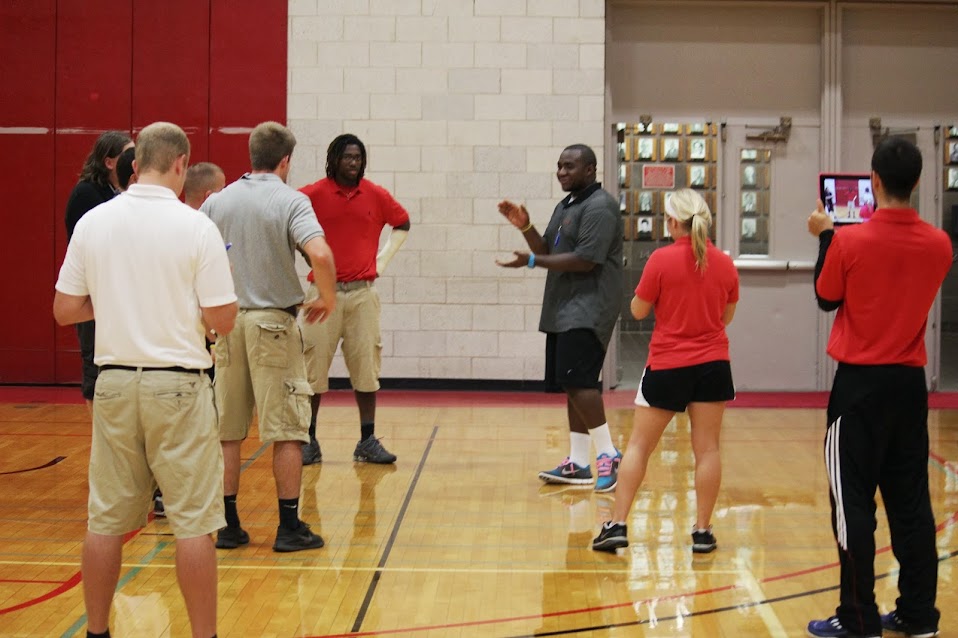
                                          Here is a photo of me giving instructions to the class.

GUT: Before the class even got started I was really nervous. My hands got really cold and I felt really shaky. The class came in and I had to just take control of the situation. In my nerves I know I made some mistakes. For example, I did not really have the best introduction. I hit everything that was needed, but it was not fluent or done in an orderly fashion. I definitely doubted myself, especially when the students asked questions. To me that felt like an indication that I did not explain that task that they were about to complete well enough. In my mind I think the students might have been a little confused, and maybe needed me to slow down and break the chunks of information up. At the end of the lab, I did feel proud about two things. I made it through without saying "guys." I found other alternatives to addressing the class like “everyone,” “class,” and “students.” I also felt really proud about projecting my voice and having some power to it. That is one area that I am really weak in; I talk as if people are standing right next to me instead of fifteen feet in front of me. To be able to improve on that was a really big step for me.

SO WHAT: In today's lesson, the Fitness Circuit was the main focus . In the circuit were four different exercises (race walking, push-ups, sit-ups and tuck jumps) that would help a person build muscular strength for fitness walking. When writing the lesson, I planned how to modify each station to either increase or decrease the difficulty for the students." Many lessons need some modification for individual students, either because the students are working above their level of ability and are not successful at the task or because they are successful every time and are not being challenged" ( Rink 2013, 145). In the Pre-assessment, all the students checked off as being either medium or highly skilled in Fitness Walking. In each station I was able to evaluate the students and make adjustments if needed. For example, one of the students was performing the tuck jump very well. To challenge him, I told him to tuck jump inside of a hoola hoop. This would challenge him to work on stability. Another situation was where a student needed support to do sit-up, and I allowed for him to put his feet pressed against a wall to help him be able to execute the proper form of a sit up. I am learning that each student is going to be able to perform a skill at a different level. By being aware of this, I can use different modifications to keep the student engaged.

Watch my videos of Fitness Walking
 Here is Part 1 of lesson  http://youtu.be/mHOVJFgpXTo 
And here is part two .http://youtu.be/34w_EEW-ChA


NOW WHAT: In this lab I learned a lot about time management. As one can see in the video, I went over the time that was required. In my organizational skills I need to be more aware of the clock and how to transition from one activity to the next. In the future I need to recognize the ability of the students and realize that they may not need so much demonstration. If they need assistance I can spot it and apply a modification to help them gain success. For my next lab I need to continue to write out scripts and review the material. The more I read and practice the more confidence I gain.


Monday, September 16, 2013

Lab A Anthony Piscitello Table Tennis


Lab A-Reflection

What?

Walking into lab A for the first time was a nerve racking experience. I did not feel comfortable speaking in front of my peers and was worried that I would exclude some of the minor details. I ended up not even introducing myself but was aware of it as soon as I finished. My eye contact was not great and I could have slowed myself down at times. Even though my instructions were clear and direct, I could have been a little bit louder. Another key point that I think that I could have done a better job with was encouraging the students and being involved with the activity rather than simply sitting back and watching the students participate. My activity was good in the aspect that all of the students were involved with maximal repetitions and no one was sitting out. 

Gut

The biggest concern of mine coming into this lab was that I was going to stumble over my words and have difficulty speaking in front of the class. I was relieved instantly when I found out that the class was going to split in half. I was concerned that my activity was not going to be good enough and that the TA's would not approve of what I wanted to teach. I soon realized that I was over-thinking the entire thing and that I just needed to go out in front of the class and do my thing. The first time around teaching I was petrified but for the second time I performed my lab A I felt much more comfortable and it got easier as I went along. I think my conclusion of the second attempt at lab A was my best in regards to public speaking.

So What?

I was speaking with my hands too much and saying "um" and this is distracting and shows a lack of professionalism. I need to become more comfortable speaking in front of my peers and maintain eye contact. I know that this will come with practice and preparation. I thought that I succeeded with my instant activities though because the students were all active for the entire time. 

Now What?

For the next lab, I know that I must speak louder, slower, and maintain eye contact. I will be drawing up index cards and reviewing my lesson several times out loud to myself will help a lot. I need to know that I am in control of the class and the students want to learn and that it is my job to educate them. 


This is me explaining the rules for Cyclops Tag.


Lab A Michael Cantelli Triathlon

WHAT? 
         During Lab 1 I was assigned to teach about a triathlon. I believe that during the lab the students learned a few things. If they didn’t already know what a triathlon was, they learned that it is a three part race consisting of swimming, biking and running. During both days of the lab I had the students perform tasks that were examples of skills used during a triathlon. One of those tasks was running, the other bicycling and the other was superman abs to simulate the motion of swimming. One of the more challenging tasks was not saying “guys” while teaching. The second time we did the lab I cut down on using guys and used alternatives like class and everyone.
 
GUT?
         I feel that the students learned as much as they could have within the 5 minute period. Overall I thought the lab went well, however the only thing that I feel went wrong was saying “guys”. However in the second go around of the lab I managed to only say “guys” once or twice. My students agreed with me and told me that my lab went well and I did happen to say guys in the second lab but made a conscious effort not to say it.
 
SO WHAT?
         My students learned what a triathlon consists of. They also learned a few fun facts about triathlons. My part in this was introducing the students to the skills needed to complete a triathlon. I had the students do the skills I chose because in relation to a triathlon those were the most accurate skills that would be used in a triathlon. I learned that I need to be more fluent when talking to the students. If I am smoother with my words then students will better understand what I am trying to say. If the students don’t understand what I am saying they will look at me with a blank stare and think “what is he talking about”. In making decisions I learned the quicker the better. I should always have a plan and keep it quick and to the point.
 
NOW WHAT?
            During these two days of teaching I have learned many things. I have learned that when speaking to the class to be smooth, fluent and loud. Also, I learned to try to not say guys when addressing the class and use alternatives like everyone and class. I think that it could only help me to be more active with the class and be a little more involved instead of just standing there and watching. I wouldn’t know what to improve on without the help of my classmates. After each lab they would tell me what I did good and what I could improve on and it is a big help!


In this picture I am explaining to the class what we are doing for the day!

Check out the video of me teaching the class about a Triathlon!
http://www.youtube.com/watch?v=YShcBUyB1PI

Lab A orienteering Jim Caswell

Lab A Reflection

What
Gut
So What
Now What


Preparing to blow my whistle to start the activity 


WHAT

For the last couple of years I have been a head coach of various sports, so heading into Lab A I had a general idea of how I needed to act as a teacher. One of the skills I brought from that was how to speak so that everyone can hear me and understand what I’m expecting of them. When I coached I only coached a team of males, so I used the word “guys” on multiple occasions. I even caught my self saying it and then said guys again the next sentence.

GUT

When I first got the activity I had to do (orienteering) I was excited, I never heard of it before so it was interesting researching it and figuring out a way to make a fun activity for my class to warm up with. The first time I taught I came up with a game that was fun, but took to long to explain so I corrected my mistake the 2nd time and got the game going right away. While I was teaching both the first and second time, I felt that I was doing a good job projecting my voice so that everyone could hear me with out a problem, and I had couple people come up to me afterwards and complement me on that exact thing.  Although I spoke very well I was a little upset with my self, especially after the second time going. I have the horrible habit of saying guys. For example “Ok guys bring it in” “alright guys”, “do you guys understand”. This is not ok and I need to change it immediately. The first time I taught I caught my self saying it a couple times but brushed it off. The second time I taught I said it about 5 times in one sentence. I started off good and then I slipped up said it once, shook it off and then I caught my self saying it again. I was embarrassed, but laughed at my mistake, as you can see in the video, and even bring attention to it (which I know I shouldn’t). Then the very next sentence after, I say guys again, at that point there was nothing to do but laugh and move on. Afterwards I was angry at my self, I made the mistake more than once, and also pretty embarrassed.  Calling a class guys is not ok, especially if there is a female in that class. It excludes the females of the class because they are not guys, so they could feel that whatever  I said, or have to say, doesn’t matter to them. PE is about the inclusion of everyone, using guys excludes some and is that is simply not ok .

SO WHAT

I don’t know why I use the term guys when there is clearly a mixed group of females and males. It could be a nervous habit, or just part of my every day vocabulary that I need to change. Calling the class guys is not a good thing at all.

NOW WHAT

I don’t feel like there is many ways to fix me saying guys other then for me to expand my vocabulary and practice it in every aspect of my life, not just in the classroom. I could make a swear jar like thing and every time I say “guys” put a dollar in.  Or instead of saying guys I need to say things like ladies and gentleman, class, everyone, boys and girls, or students.


Teaching the class


Lab A - Gideon - Aerobic Kickboxing


What?The Activity that I was given for Lab A was Aerobic Kickboxing.  The instant activity that I related to the main activity is called Ninja.  How the activity started was getting all the student's foot together, then eventually they would all jump off and each would have a turn to jump/tag the person that is next to them.  The person who is getting tagged can dodge from their tagger by jumping away from him/her, and then can jump again to tag their opponent.  It's almost like a game of knock out.  I gave them a visual that they were in ancient japan and before each student had to tag their opponent, they had to say their name + sama (Master in Japanese).  And while they were playing, I played a traditional Japanese song to set the mood.  The focus of this game in a way to simulate Aerobic Kickboxing was that it involved explosion with the whole body to attack one target.  One big cardinal rule I broke in this game was that I set the rules where if the students got tagged, they were out. 

GutI'm always excited to teach something to students especially if it's something I believe the students would enjoy very much but what I tend to do is lose a part of my professionalism.  I got the students to be excited and enjoy the game, and get their heart rates up, but I broke some more cardinal rules.  For the 1st Lab A, I didn't give out a safety statement, I said "guys" and a signal for attention.  The second activity, I did my safety statement and gave a signal for attention but I forgot to say my own name and my rules were a bit too long to explain.  I also made sure I said "class" in the beginning, but from then on I said guys again.  So overall, I feel that I got the energy, the creativity, the thing is I feel I need to balance it with my professionalism. 

SoWhat?The reason why it's bad to create a game where students get out is because it gets them inactive, causes boredom, and makes them more likely to be disinterested for the main activity.  I have to remind myself to not say "guys" in a class anymore because it is disrespectful and in a way it excludes the girls/women in class.  With my name, call for attention and safety statement, I should create an order to go by, that way I would less likely forget and it'll become a good habit.

NowWhat?Next time, I'll figure out a way to create either a point system or if someone is out, for someone else to save them so they can get back in the game rather than getting out for the whole game.  I would also practice for this whole semester to not say guys, inside and outside of class. I would also rehearse myself to do the activity but to emphasize the order from saying hello to my "class" to my "name" to explaining the game to "safety statement" to "calling for attention". 

Photo
  I'm in the middle watching my class have fun


This is me bringing up the instant activity game called Ninja

Sunday, September 15, 2013

Lab A John Odle Self-Defense


What?
When I picked my topic for Lab A I was a little nervous about having to come up with an Instant activity that related to my topic. After some meditation I remembered that I had taken a self-defense class and I felt a lot better. My first crack at Lab A I thought went smoothly but still had a couple bumps in the road. One mistake that I had was that I used the phrase “Um” frequently. I knew that it was something that I was doing but it was kind of hard to break that habit. My first instant activity, even though it was related to the topic, took too long to explain so it wasn’t so “instant”. My second lab A I felt more confident about the task at hand. My instant activity was good and got the heart rate up and the students involved right away. I did feel that I was speaking too fast and might have lost some of my students, so that is something that I would have to work on for Lab B.

Gut
I felt that my second time doing lab A went much better because I knew what I needed to do better and I definitely felt that I accomplished that. My instant activity, even though it was just a simple tag game, related more to my topic of Self-defense. I felt that I had more confidence going into this as well. I had a lot more eye contact with my students and just all-around felt good. I still feel like I could have done better but practice makes perfect. Also, the feedbacks from the TAs and Dr. B and my peers really did have an impact on how I did and how I will be.

So What?
I know that practice makes perfect so I’m not going to beat myself up too much for the mistakes that I made. We are all learning and this may be some of our first times doing something like this. I know that with more experiences like this I will get better as a student teacher and an instructor when I get a job. The cool thing about this job is that it is very fun and innovative so we can do so much things with it that I know that I will get better.  

Now What?
For next I have to be more prepared for the Lab. I was prepared for Lab A but maybe not as prepared as I should have been. Speaking slower, and using the phrase “um” was a big part of my criticism and now that I know what to work on I can just get better form here.


Showing the students my signal for Attention which is "If you can hear me Clap once, If you can hear me Clap twice."


Watch my video of me teaching Lab A for the second time

Lab A Andrew Billups Badminton

Lab A - Reflection


WHAT

When I first learned what we would be doing for Lab A I was nervous. I felt that I wouldn’t be able to get my information across as quickly I wanted and get the students moving. For both days I focused on being short and to the point so the students could get straight to the activity and moving. I feel I did a good job on doing that. What I need to work on is addressing the students as a whole and not just the “guys”. It’s not fair to any of the females in the class. The second day I did a much better job with using gender-neutral terms.

GUT
I was nervous, because at first I couldn’t think of any instant activities that would relate to badminton. Especially not using any equipment. Once I found a few ideas I was able to get more confident on my teaching. The first day of teaching was the most nerve racking. I wasn’t sure how the instant activity would go and if it really would relate to my unit. On the second day of teaching most of the nerves had calmed down and I was ready to teach. I was much more focused on what I had to go over and spoke up much better also.

SO WHAT
Since I was a little nervous I kept playing with my hands and moving a lot when I was talking. I need to work on this because the students can get distracted by my movements not pay attention to what messages I am trying to get across. On the positive side I had instant activities that the students enjoyed doing. This resulted in them being even more interested on what they were going to be learning in that class.

NOW WHAT
These two days of teaching I have learned a lot. Now, when I have to teach the next time I know what I need to do because the help of my peers. I know that I need to speak louder, move around and communicate with the students more when they are in their instant activity. Also I need to speak to the class as a whole and not say “guys”. I can not wait to teach again, and show my self that i am only getting better


                                             Explaining how the rules to the instant activity


Watch my video of me teaching Lab A for the second time


Anthony Tiziani Lab A- Golf


What?
When I first found out what I was going to do for Lab A, I was a little bit stumped on how I was going to relate an instant activity to golf. During the first time teaching lab A my activity didnt really have any benefits for golf. I had to reevaluate what my instant activity was going to be the second time because I needed to be more specific to what part of golf I wanted to focus on. I decided to focus in on the weight transfer between feet while hitting the ball. I was also very nervous the first time teaching but calmed down alot the second time.
Gut
I felt as if my second time doing lab A went alot better than the first time because it was more directed to golf and had components that would have helped the students become better golfers. I tried thinking to hard about what my first activity was going to be because I tried to teach about golf in general instead of a certain part of golf. I was also more preparred the second time because I really thought about what I was going to say and when I was going to say it. That made me more calm and confident.
So What?
It is very important to remember that not everything can be taught in one day or in one week. Things need to be learned in small pieces many times because if there is no building blocks for what you are teaching then you cant advance and get more complex. Also, if I am not preparred then it is very hard to be confident because I am always trying to think of what to say next instead of knowing what to say next.
Now What?
Next time when I am just starting to introduce a topic or am doing an instant activity I will remeber to keep it simple and specific. I will also practice my lesson more whether it is using friends /family as my class or even just a fake class in the mirror.

Me explaining to the class what to do as an instant activity for the day!!


Watch the video of the second time I taught lab A!!


Lab A Tom Hughes Cycling

What: I found it difficult to come up with an instant activity that had to do with cycling.  I ended up playing a game called "cars on the road" that I normally played with the younger kids at summer camp.  I saw this game as a good way to keep the heart rate up and simulate cycling.  My two mistakes in my first lab were saying "guys" instead of "class" or "students", and forgetting to state a safety statement.  My second lab A I felt way more confident about.  I made sure I didn't say "guys" but still forgot to say a safety statement.  I know that I need to focus on this category for my next lab.  Even though my second lab was just a tag game, I related it to cycling and gave the students good feedback and I corrected them if they were doing the exercise wrong. 

Gut: I felt that I had everything that I wanted to say planned out, but then when I started teaching I skipped some key features like my safety statement and forgetting to set boundaries in my second lab.  Although I forgot some key statements, I still felt like I was engaged with the students and provided good feedback. 

So What: Having the students run worked on cardiovascular endurance and having them do jumping jacks and bicycle kicks when the students were tagged worked on muscular strength and endurance. I used these two exercises because they relate to the unit of cycling in the aspect of riding a bike (bicycle kicks) and pumping up a tire (jumping jacks).  In my next lab, I will work more on teaching the students something that they don't know already and will keep them engaged on the topic.

Now What: Now that I have had feedback from my peers, I will be able to work on my weak points and make sure that I meet all the requirements for the lab.  I now know not to say "guys" anymore, and that a safety statement is very important, as well as setting boundaries so the activity stays contained.  I will also work on speaking more clearly with confidence. 


Demonstrating to the class on how to do a proper bicycle kick


This is the video from my 2nd Lab A, playing Cycling Fitness Tag!

Lab A Dylan Everleth YOGA

Lab A Dylan Everleth YOGA
Reflection


WHAT:
The first day I taught lab A, I came into the class very nervous about how I was going to do and nervous that I would leave something out of my lesson plan. As I began to teach, I did a good job at following exactly what was required for Lab A. Unfortunately, I forgot the most important part about teaching. As I was focused mainly on the requirements for the class, I forgot to encourage the students. After I started the instant activity, I basically stood there and watched while the class took part in the activity. I was so caught up in focusing on what was required for the lab, that I left out what really matters in teaching a lesson in phys. ed. The night before the next day of teaching, I thought a lot more about focusing on the students and their activity and not just staying strict to the plan. When I taught for the second time, I felt much more relaxed, my mind was clear and I feel I gave great feedback to the students while they participated in my instant activity. I was much more confident with my teaching on the second day and felt I did a much better job and giving the class feedback and motivating them during an activity.

GUT:
When I came in the first day to teach lab I was very nervous. This was the first time that I was going to teach a group of people. I was so caught up in making sure that I didn't leave any of the requirements like saying my name, not having a good enough instant activity, or explaining my activity well enough that I forgot about focusing on the real aspects of teaching. The closer and closer it got to being my turn to teach, I got more and more nervous. I kept thinking that my activity wasn't going to be good enough or that people were not going to like my ideas or think that I was unprepared. As my turn came, I began to talk really fast and tried to go down the list of things that I had to make sure to include in my lesson. I got a chance to calm down when my instant activity was going on and during my conclusion to the lab I was much more relaxed. I realized that there was really nothing to be embarrassed or afraid of. The second day I came in much more confident, I felt that I spoke much more clearer and that my lesson went a lot smoother. Now everything is going to get easier and easier from here.

SO WHAT:
Giving feedback to students and motivating them with compliments is great for building the confidence of students in the class. When a student hears that they are doing a good job, it motivates them to want to continue to get praised and participate. This is something that is very important to do during a lesson because it keeps students wanting to come back. As stated in the text, "Teachers will motivate students in different ways." (Rink, 2010, P18). This is very important because there really is no specific way to motivate students. Every teacher has a different way that they give students confidence. It doesn't matter what style you use, it matters that you give the students the motivation to want to keep coming back and get better. I need to realize this and discover which way of giving motivation suits me best. As for being nervous, that is just something that comes when doing new things, the more and more I continue to practice, the more comfortable I will become.

NOW WHAT:
For my next lab I am going to come into it much more confident, I am going to forget about being embarrassed and become a great teacher. I am going to give the students the feedback they need and help them improve in skills. My goals for next lab are to relax and come into the lab confident in what I do. Also, i'm going to get involved with the lesson by motivating the students and not be the teacher that stands off to the side. Confidence is going to be a tough thing to improve but I believe that over time I can eliminate the factor of being nervous. I look forward to looking over the things I need to work on and come into Lab B prepared and ready to make a difference.

Here I am giving the class an introduction to the Yoga 
unit and explaining the instant activity for the day.


Its important to give students feedback while they are doing an
activity. By giving compliments when they do something well, 
students build confidence in what they're doing.